3-H Project Online Meeting | 30th Pan-EU Conference on Digital Education
As many of you already know, ENAC is implementing a KA2 project entitled 3-H project (Head, Heart, Hand) with the aim of preventing early school leaving in vocational education and training, using methodologies that facilitate the acquisition of socio-emotional skills.
On Thursday 29 September, an online event will be held from 3pm to 4.30pm, focusing on the presentation of good practices implemented by teachers and trainers in their educational settings. The event is part of the 30th edition of the European Conference on Digital Education and the presentations will be given in English by trainers from England, Italy, Spain and Romania. Click here to see the event poster
The topics covered in the presentation of good practices will be as follows:
Click here to see the event poster The topics covered in the presentation of good practices will be as follows:
Reception and orientation activities: reception practices for incoming students with previous negative school experiences, in order to facilitate their integration into the new IeFP programme. Register for the event
Self-directed learning: understood as a learning process in which the student takes the initiative and becomes increasingly autonomous in defining what to learn, how, when and with whom.
PBL (project-based learning) to develop social and emotional skills: good practices to support trainers in implementing meaningful PBL activities that enable students to develop social and emotional skills.
Well-being and motivation at school: practices to create a welcoming, engaging and inclusive school environment.
The partners of the 3-H project meet in the Netherlands second LLTA
From 13 to 16 June, 15 trainers from four different countries gathered in Leeuwarden, the Netherlands, for two intense days of training. The partners were welcomed by Friesland College to carry out the second Learning Teaching Training Activity (LTTA) of the 3H project, funded by the Erasmus+ programme (find out more about the project). For those who don’t know, LTTA stands for “Learning Teaching Training Activity”, i.e. practical and experiential training sessions held abroad, bringing together teachers and trainers from schools and training institutions in different countries. During the first day of training, the focus was on Serious Gaming: serious games are engaging and immersive types of games used to promote learning and behavioural change. In fact, serious games combine learning strategies, knowledge, structures and game elements to teach specific skills and attitudes; they are designed to solve problems and, as a result, involve challenges and rewards. At Friesland College, serious gaming is used as a methodology to encourage the development of soft skills in students. The trainers involved in the 3H project attempted to solve a series of puzzles in order to escape from an escape room in the shortest time possible. They then reflected on the experience, the different personalities involved, analysed each person’s communication style and the contribution that each individual made to the group. The participants also got involved by trying to invent serious games themselves, using the design thinking methodology to structure and test the games.
Subsequently, the ‘5 wisdom theory’ was explored in depth: this ancient Tibetan theory has been adapted to the school context of Firesland College and is based on 5 key words, which correspond to the colours green, yellow, red, blue and white, and on the concept of open and closed; it starts from the perspective that each colour refers to a set of characteristics and a particular communication style. The terms “open” and “closed” refer to the degree of openness towards the outside world. For example, a person who falls into the “open red” category will be more involved with others, more empathetic and predisposed to listening, while “closed red” refers to a fragmented individual who needs attention and is overly emotional. It is important to emphasise that no one falls exclusively into one colour category: we are all a mix of colours depending on the situation we find ourselves in at any given moment.
Thanks to learning this methodology, Friesland College students have become more flexible in analysing reality, and interpersonal conflicts among them have decreased.
The last day of LTTA ended with an “Outdoor learning experience” called Walk of Life, with the ultimate goal of encouraging students to reflect on their careers and take a leadership role in their own lives. The trainers took the students on a unique walk through Leeuwarden; The walking route was structured so that each of the five stages shed light on a different professional skill, such as: quality of work, motivation, career choice, networking and exploration. It was an opportunity to test first-hand how Friesland College tries to develop so-called “Career Competences” in its students, i.e. those skills that prepare them for a successful transition into the world of work.
Special thanks to Friesland College for hosting us and many thanks to Ron Arends, Peter van der Heijden and Alinda Wigarda-Kiel for the training sessions. The next LTTA of the 3H project will be held in October in Oulu, Finland.
Thanks to the Erasmus+ programme, from 5 to 26 June, some ENAC Puglia students had the opportunity to undertake a three-week training internship in Copenhagen at the Copenhagen Hospitality College: the city’s most important hotel school, with around 900 students, offering professional courses in pastry, bakery, bread making and gastronomy.
The college has a canteen and a teaching restaurant, both used for lunch breaks by students and staff, and it was here that the ENAC Puglia students actively participated in the daily preparations, completing the tasks assigned to them in complete autonomy. Based on the excellent results, the Danish tutors gave them the opportunity to organise two Italian-style menus: both events were overbooked, something that had never happened before!
In addition, a training day was organised at UN City: a complex that houses 11 UN agencies, with 2,000 employees and two campuses. Here, the students took part in a masterclass on natural food fermentation processes and collaborated in the catering service for UN City employees.
The students demonstrated their professionalism, technical skills and autonomy in an external context that was numerically challenging compared to our training environments. They communicated in English with tutors and students and were appreciated for their friendliness and cheerfulness.
In May 2022, a seemingly diverse group of vocational education and training professionals took part in an Erasmus+ staff mobility programme for a guided tour of Nova College in Haarlem, the Netherlands. Trainers, adult education operators and project managers, a total of eight members working in Canossian educational institutions, travelled to the Dutch town with the aim of observing the management of a large training centre, different from ours, which is part of a school system that differs from the national/regional one, in order to learn good practices that could be scaled up in our local contexts.
Many aspects of Nova College in Haarlem immediately appeared innovative:
Each sector dedicated to professional training has a specific building with modern, technologically advanced equipment.
The organisational chart of roles and job descriptions for employees is defined and structured in such a way that the “teachers” committee’ and “students” committee’ also play an essential role in defining programmes and development strategies for the complex, in addition to the board of directors.
Great attention is paid to the student, with training that “encourages” the process of individual empowerment, appropriately supported by different levels of coaching, mentorship and peer education.
Last but not least are the internship and internationalisation programmes, which aim to make users increasingly autonomous in their professional choices and capable of meeting the expectations of employers.
Everything is integrated with synergy and synchronism in a swarm of ideas, relationships and “horizontal” experiences, where the creative power of the student is no less considered than the more conservative experience of the trainer. As a corollary to the travel programme, there is an excursion outside the city strictly by bicycle, a visit to some museums in Amsterdam, the freckles of the people and excellent beer accompanied by sweet French fries. Tot snel Holland!
Creative Skills 21 Project: second learning week in St. Gallen
From Arganzuela to Roter Platz, from Chueca to Vadianplatz, from Lavapiés to Marktplatz and so on, the names of the teams change – as do some of their members – and the second training week of the CS-21 project – Creative Skills 21 – Improving teaching and learning of 21st century skills for the creative industry for the year 2021/2022 can begin.
The week, initially scheduled for February and then postponed once again due to COVID, took place from 16 to 20 May in St. Gallen, Switzerland, and, as planned, saw the groups finalise the project idea developed last November in Madrid. The activities kicked off on Monday morning at GBS Saint Gallen, a training and professional development centre located at the top of the hill in the town of the same name. For ENAC, the group of students remained unchanged, with four fourth-year students from CFP Canossa in Magenta, while the technical teacher changed. The students rejoined their groups and immediately set to work to re-discuss what had been decided previously and to refocus the objective: to develop a communication campaign to raise awareness among a specific target audience on the issues of inequality. The teachers, on the other hand, after meeting with their groups again, were invited to a workshop on Critical Thinking, the skill of this second learning week.
The second day proceeds in much the same way, with the groups working on their projects and some reflection among teachers and coordinators on their role in the groups and how to apply what they learned the previous day within their teams. Tuesday ends with a social dinner and a walk in the hills surrounding the city.
Wednesday morning is again devoted to project development, while in the afternoon, participants recharge their batteries with a guided tour of the city and the Abbey Library of St. Gallen, a UNESCO World Heritage Site since 1983, ending with another walk in Appenzell.
On Thursday, the students are asked to complete their work and put together a presentation for the following day: they will have to present their message, their chosen target audience, the process they followed, their idea and how each member of the group contributed to its realisation. The teachers accompany them in the exercises and also attend the presentation of some good practices on blended learning, app and video creation, as well as an exhibition on augmented reality.
Finally, Friday arrives, and the groups take turns on stage to present their work to the jury: seven projects that bring together the students’ many creative skills, all aimed at promoting sustainable development goals 4, 5 and 10, namely quality education, gender equality and reducing inequalities. Each presentation clearly highlights the different technical skills of the individual participants, as well as their equally important cross-cutting skills, such as communication and cooperation. It is time to say goodbye to these 42 participants, who pass the baton to the same number of students and teachers for the autumn training weeks to be held in Finland and Portugal, in which ENAC will participate with four students and two teachers from the SFP in Verona.
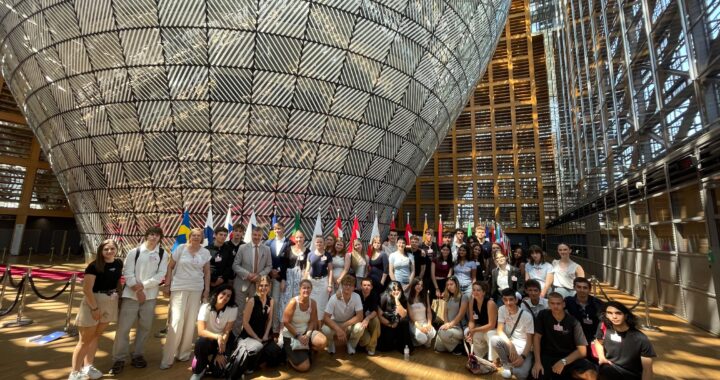
Dal 23 al 25 maggio si è svolto a Verona il meeting del progetto Erasmus KA2 DOCE – Digital and Online Creativity Education a cui hanno partecipato più di 30 educatori provenienti da Olanda, Belgio, Finlandia, Portogallo, Spagna, Regno Unito e Svizzera.
Il progetto è nato nel 2021 in seguito alla pandemia da COVID-19 che ha accelerato la necessità di modernizzazione digitale dell’istruzione e della formazione in tutta Europa. Infatti, l’obiettivo di DOCE è proprio quello di far progredire e rafforzare la capacità dei docenti della IeFP di sviluppare e offrire un’istruzione digitale efficace, di alta qualità e inclusiva all’interno del settore creativo.
Era la prima volta che i partner si incontravano di persona e per rompere il ghiaccio è stata organizzata una attività di improvvisazione teatrale per presentarsi agli altri partecipanti rivisitando la famosa scena del balcone tratta da “Romeo e Giulietta”. In seguito, i partner si sono confrontati sugli ostacoli e sulle difficoltà legate alla pandemia e alla DAD, scambiandosi a vicenda feedback, buone pratiche e consigli. Il primo giorno sono state tenute alcune masterclass riguardanti la didattica online:
Apprendimento visivo, virtuale e interattivo: cos’è “Thinglink” e quali possibilità offre agli studenti e agli insegnanti? Ai partner è stato assegnato un compito da svolgere in piccoli gruppi misti nel corso dei 3 giorni di meeting: ogni team doveva creare una lezione digitale per studenti tra i 17 e i 22 anni, legata ad un aspetto culturale o artistico di Verona della durata di 30 minuti. La lezione poteva essere concepita per svolgersi in DAD, oppure per essere scaricata dagli studenti tramite download e doveva prevedere una forma di valutazione di apprendimento dei contenuti (es. quiz). C’è chi ha progettato una lezione sulle basi della composizione fotografica utilizzando gli inconfondibili scorci di Verona, chi ha realizzato un sito web con foto panoramiche per conoscere meglio Piazza dei Signori e chi ha immaginato di trasformare Porta Borsari in una mostra d’arte contemporanea proiettando delle immagini sul monumento.
Di grande impatto è stato l’intervento tenuto dal ricercatore di fama mondiale in campo educativo, Pedro De Bruyckere, il quale ha trattato diversi temi dando molti spunti su cui riflettere ai partecipanti, tra questi: online/creativity learning, l’importanza della motivazione per l’apprendimento scolastico, autonomia e libertà nelle scelte scolastiche, fake news e bias cognitivi. Grazie a tutti i partecipanti per essere stati con noi e per aver condiviso le proprie competenze e abilità professionali: è anche grazie a questo tipo di esperienze e al confronto con l’estero che ci miglioriamo come persone e come ente di formazione!
Well begun is half done: kick-off meeting for the 3-H project
Fourteen partners from Italy, Spain, the Netherlands, Croatia and Finland attended the kick-off meeting for the 3-H project, held on 24 and 25 March 2022 in Verona. The 3-H (Head, Heart, Hand) project is based on the assumption that VET should provide a holistic education, i.e. an education that takes into account cognitive intelligence (head), social-emotional intelligence (heart) and manual intelligence (hand) in equal measure. The project focuses on socio-emotional aspects and aims to equip VET staff with methodologies for managing student demotivation. Considering that in several European countries there are examples of schools that are incorporating socio-emotional aspects into their learning pathways, the project aims to study some of these experiences and the approaches behind them in order to replicate them in Italian and Spanish VET contexts.
The event was dedicated to increasing mutual understanding between partners and planning upcoming activities in detail. During the first year of the project, the partnership will focus on gathering existing best practices related to these four topics:
Welcome/orientation activities: welcome practices/programmes/activities for incoming students with previous negative school experiences, in order to facilitate their integration into the new IeFP pathway.
Self-Directed Learning: an active learning process in which students take the initiative and decide independently on their own learning path (what to learn, how to learn, with whom to learn, when to learn).
PBL (Project Based Learning) on social-emotional skills: supporting educators in implementing meaningful PBL activities that enable pupils to develop social-emotional skills and learn authentic content. In other words, PBL design projects that have a social-emotional component.
Well-being and motivation at school: practices to create a welcoming, engaging and inclusive school environment that transforms the relationship between the institution and students and generates a state of well-being.
The methodology behind the project is simple: on the one hand, partners who have developed good practices on the project topics over the years will transfer their successful models and expertise; on the other hand, partners with less experience will be trained on these topics and will seek to adapt these good practices to their national contexts.
“Travelling is like dreaming”: the story of Emanuele Belloni from ENAC ER
By Emanuele Belloni
Internationalisation has always been very important in my life and has also had a major influence on my work experience to date. Since I started working for ENAC Emilia Romagna, my trips abroad have always been with my students, as a chaperone and tutor. However, for the first time, I had the opportunity to take part in a European project thanks to the REX VET LTT workshop I attended in Helsinki, which gave me the opportunity to join a group of foreign colleagues.
Sharing information, ideas, experiences and suggestions was really important for my professional growth. I learned a lot during these three days of work. I came back from Finland full of positive energy and inspiration, which I am trying to transfer to my daily work at my vocational training centre. This experience was significant because I also had the opportunity to visit Helsinki, where I had never been before. I really enjoyed the Finnish hospitality and it was really nice to meet new people from different countries. Travelling to a foreign country and meeting foreign people always makes me feel more open-minded.
There is a quote by Edgar Allan Poe that I love: “Travelling is like dreaming: the only difference is that not everyone, once awake, can remember their dream. Instead, everyone has a vivid memory of the journey they have returned from.” Let’s say that this business trip to Helsinki was like a dream for me. Now I’m back to reality and my students, but I keep thinking about everything I experienced there.
Legnano/Alicante cultural exchange: a unique experience
By Anna Pekez and Benedetto Rossi, Year 2 Social Economics students at the Barbara Melzi Institute in Legnano
During the month of February, we, the students of the second year of the Liceo Economico Sociale at the ‘Barbara Melzi’ Institute in Legnano, had the opportunity, thanks to Professor Manuguerra, to take part in a cultural exchange with students from the Cavanilles school in Alicante (Spain).
This gave many of us the chance to improve our Spanish language skills and learn new vocabulary for everyday life.
The same could be said of the cultural aspect, discovering customs and a different way of life in an environment with traditions different from our own. We were able to observe their lifestyle, particularly in our homes and families, who in turn were very happy to welcome the Spanish students.
The school organised various activities and educational trips to help us get to know our local area, visiting Milan, Como and Legnano. For our guests, it was a new adventure and for some of us, it was a rediscovery of interesting cities, or even, for those who had never had the opportunity to see monuments and attractions such as the Last Supper or the Voltaian Lighthouse in Como, a fantastic first visit. A different experiment was the art workshop, in which we expressed our creativity by colouring our photos with the aim of showing ourselves before and after this “event”.
The experience was wonderful, but after nine days of commitments, proposals and outings involving all our families and the entire class council, returning to school was tiring, especially in terms of the school routine.
The best part of this experience was forming new bonds in such a short time. It was very important for all of us to have made friends, which have lasted until now and which we hope to strengthen and maintain in the future.
European Vocational Skills Week: #DiscoverYourTalent
The sixth edition of European Vocational Skills Week will take place from 16 to 20 May 2022. It is an initiative of the European Commission to raise awareness and increase the attractiveness of vocational education and training (VET). The week aims to make VET more interesting in order to help young people and adults reach their full potential for a more fulfilling personal and professional life.
The motto of this year’s communication campaign is
DiscoverYourTalent!
The motto aims to show that everyone has valuable talents and that VET can provide European citizens of all ages with the skills and practical knowledge they need to succeed in the labour market.
This year’s theme is VET and the Green Transition, in line with the European Commission’s European Green Deal: its plan to become carbon neutral by 2050 – and to provide everyone with the tools they need for the green transition.
The aim is also to raise awareness of VET experiences among individuals and organisations, thus creating a library of stories to inspire others. A selection of stories will be promoted through EU channels.